Burntide Official Website › Blog › How much of a gummy is the supplement
How Much Of A 2.5 g Gummy Is Actually The Supplement?
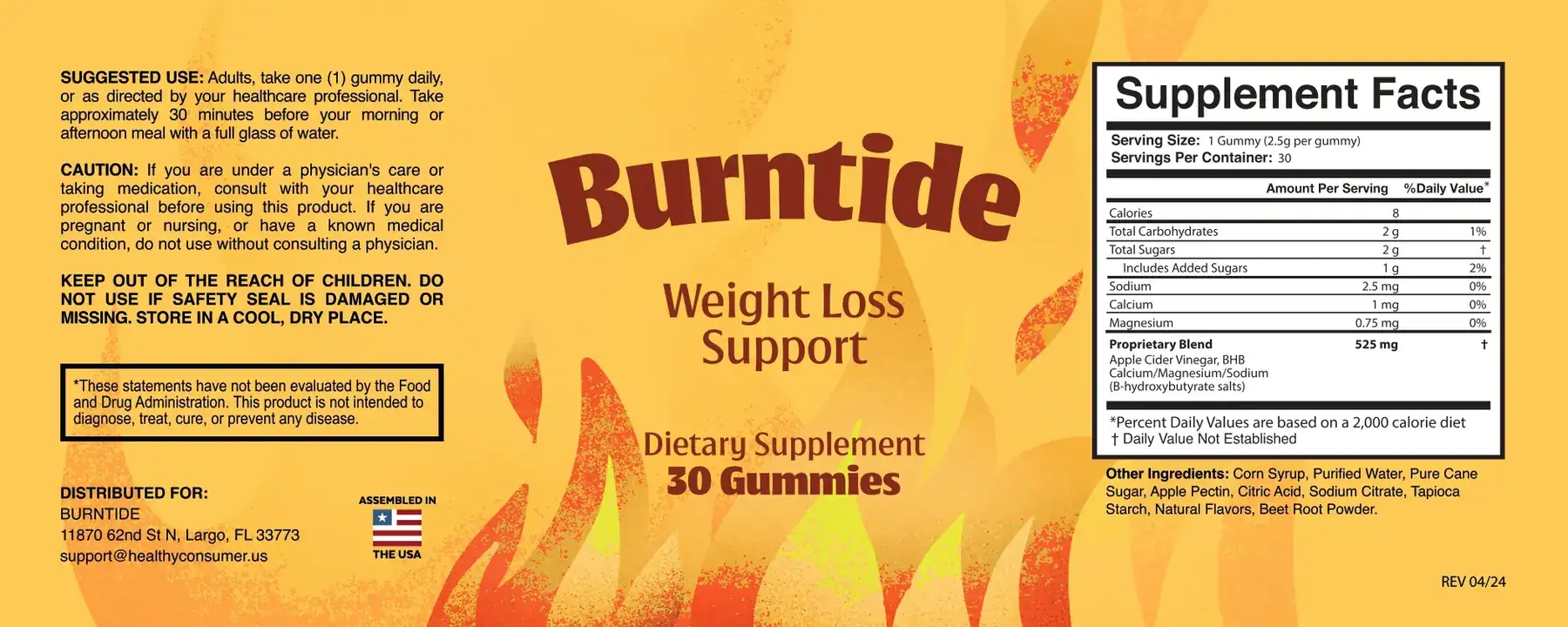
- A Burntide gummy weighs 2.5 g and carries a 525 mg proprietary blend, so roughly 21 per cent of it is the supplement.
- The other four fifths are corn syrup, water, cane sugar, apple pectin, citric acid, sodium citrate, tapioca starch, natural flavors and beet root powder.
- This is normal for a gummy and it is not a scandal. A gummy has to be a sweet before it can be anything else.
- It is the reason a gummy cannot carry a research dose of most ingredients, which is the trade you are making when you choose one over a capsule.
- Both numbers are on the panel, so you can run this arithmetic on any gummy in any shop.
The arithmetic, in one line
The Burntide Supplement Facts panel prints a serving size of one gummy at 2.5 g per gummy, and below it a single Proprietary Blend at 525 mg. Those are the only two weights on the panel that describe the whole product rather than a trace mineral.
525 mg out of 2.5 g is 525 out of 2,500, which is 21 per cent. Rather more than a fifth of the gummy is the thing you are buying it for, and rather less than four fifths is not.
Almost nobody runs that division, because almost no label invites you to. It needs both the serving weight and an active total, and plenty of gummies print only one of the two. This one prints both, which is a point in its favour before anything else is said.
What the other four fifths are doing
Under the Supplement Facts box the label prints a second list headed Other Ingredients, in descending order of weight as the rules require. It reads: corn syrup, purified water, pure cane sugar, apple pectin, citric acid, sodium citrate, tapioca starch, natural flavors and beet root powder.
Every one of those is doing a job, and none of them is an active.
| Ingredient | What it is for | Could it be left out? |
|---|---|---|
| Corn syrup | Bulk, sweetness and body. The largest single component of the gummy by weight | Not without replacing it. Something has to be the body of a chewable |
| Purified water | The solvent the gel is made in. Most of it is driven off during setting | No |
| Pure cane sugar | The second sweetener, and the reason the panel prints 1 g of added sugars | It could be reduced, at a cost in taste |
| Apple pectin | The gelling agent. It is what makes this vegetarian rather than a gelatin gummy | No. Something has to gel |
| Citric acid | Sourness and pH control. Not the vinegar and not an active | Reducible |
| Sodium citrate | A buffer working with the citric acid. Also a second source of the sodium the panel declares | Reducible |
| Tapioca starch | Dusting starch, so the gummies do not weld together in the jar | Not on a chewable that ships in a warm van |
| Natural flavors | Taste. A legal category rather than a named ingredient | Not if anybody is going to chew it twice |
| Beet root powder | Colour. It is why the gummies are red rather than amber | Yes, cosmetically |
Read that table and the honest conclusion is that a gummy is a confectionery product with a supplement in it. That is a description rather than an accusation, and it is the first thing to understand about the whole format.
See the Burntide panel for yourself
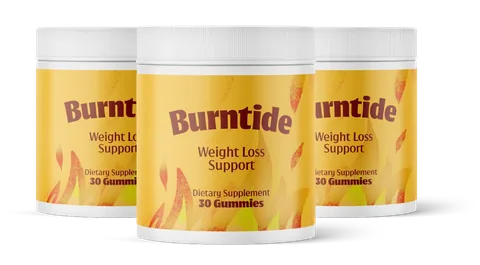
Both numbers are printed on the jar: 2.5 g a gummy and 525 mg of blend. Thirty to a jar, one a day, and sixty days to change your mind.
Price shown at checkout · 60-day guarantee
Order Burntide On The Official WebsiteWhy a gummy cannot hold much more than this
There is a physical ceiling and it is not a marketing decision.
A gummy sets because pectin forms a gel with sugar and acid at the right concentrations. Push too much powdered active into that matrix and three things go wrong at once: the gel stops setting reliably, the texture becomes gritty, and the taste becomes impossible to mask. Bitter and sour actives are the worst offenders, and dried vinegar and mineral salts are both.
Manufacturers therefore work backwards. They decide how much active the matrix will tolerate and how much taste can be covered, and the label prints whatever number survives. A blend around half a gram in a two-and-a-half-gram gummy is a typical answer to that problem, and it is why gummy versions of almost anything carry less than the capsule version.
- The dose ceiling is low, usually a few hundred milligrams of active in total.
- Sugar is not optional. It is structural, which is why almost every gummy supplement declares added sugars.
- Strong-tasting actives get used sparingly, because covering them costs more sugar and more flavour.
The same arithmetic on a capsule
Run the identical division on a capsule and the answer is very different.
| Format | Typical unit weight | Typical active load | Active share |
|---|---|---|---|
| Chewable gummy | 2 to 4 g | 200 to 800 mg | roughly 10 to 25 per cent |
| Burntide gummy | 2.5 g | 525 mg | about 21 per cent |
| Size 0 vegetable capsule | about 0.1 g empty | 400 to 600 mg | most of the filled weight |
| Tablet | 0.5 to 1.5 g | up to about 80 per cent | most of the weight |
A capsule shell is a container rather than a matrix, so almost all of the filled weight can be active. That is the entire reason a capsule can carry a dose a gummy cannot, and it is worth knowing before you choose a format on taste alone.
It is also why a product sold in both formats will often have different amounts in each, and why comparing a gummy against a capsule by counting units rather than milligrams gives you the wrong answer.
What it means for the dose you actually get
On this label the blend is 525 mg for two named actives together, and it does not publish how that splits. Apple cider vinegar is listed first inside the blend, so under United States labelling rules it outweighs the three ketone salts combined.
Set that against the research. The twelve-week vinegar trial used 15 to 30 mL of liquid vinegar a day. The exogenous ketone work used drinks measured in grams. Both are far above what a 525 mg blend can supply, and the format is the reason.
That is the honest version of the trade. A gummy buys adherence, which is genuinely worth something, and it costs dose, which is also genuinely worth something. A review of obesity supplements makes the general point that dose is where most of this category falls down.
If you want the detail, the actives and amounts page takes each of the five named ingredients in turn, and the panel page reads every row.
Running this check on any jar in five minutes
The method needs nothing but the label and works on any gummy on any shelf.
- Find the serving weight. It is in the serving size line, usually in brackets: “1 gummy (2.5 g per gummy)”. If it is not there, the label will not let you do this check at all, which is itself informative.
- Add up the actives. Every amount inside the Supplement Facts box, including a blend total if there is one. Ignore the Other Ingredients line; none of it is active.
- Divide and convert. Actives in milligrams, serving in milligrams. One gram is 1,000 milligrams, and mixing the units is the only way to go wrong here.
- Read the answer as a share. Ten per cent is low, twenty is ordinary, thirty is good for a gummy.
- Then ask the real question. Not what share is active, but whether the absolute amount is anywhere near what the research used. That one needs a search engine and five more minutes.
The NIH consumer guidance on dietary supplements is the right place to start on that last step, and the proprietary blends guide on this website sets out a six-step version of it.
When a gummy is worth the trade anyway
Everything above argues that a gummy carries less active than a capsule. None of it argues that a gummy is pointless, and it is worth finishing on the other side of that.
A supplement you do not take has a dose of zero. Adherence is the single largest variable in whether any daily product does anything, and a chewable attached to a meal is much easier to keep up than a capsule in a cupboard. The Burntide review record bears that out: six of the eight reviewers on record describe the habit sticking rather than describing a result.
So the honest summary is that a gummy is the right format if the alternative is not taking anything, and the wrong format if you specifically want the amount the research used. On this label the second case is clear cut. 525 mg is what it is, and a bottle of liquid vinegar from a grocery shelf is a fraction of the price.
What a reader should take away is the method rather than the verdict. Two numbers, one division, five minutes, any jar.
Sources cited in this post
- U.S. Food and Drug Administration. Dietary Supplement Labeling Guide. https://www.fda.gov/food/dietary-supplements-guidance-documents-regulatory-information/dietary-supplement-labeling-guide
- Kondo T, Kishi M, Fushimi T, Ugajin S, Kaga T. Vinegar intake reduces body weight, body fat mass, and serum triglyceride levels in obese Japanese subjects. Biosci Biotechnol Biochem. 2009;73(8):1837-43. PMID 19661687. https://pubmed.ncbi.nlm.nih.gov/19661687/
- Stubbs BJ, Cox PJ, Evans RD, et al. On the metabolism of exogenous ketones in humans. Front Physiol. 2017;8:848. PMID 29163194. https://pubmed.ncbi.nlm.nih.gov/29163194/
- National Institutes of Health, Office of Dietary Supplements. Dietary Supplements: What You Need to Know. https://ods.od.nih.gov/factsheets/WYNTK-Consumer/
- Rios-Hoyo A, Gutierrez-Salmean G. New dietary supplements for obesity: what we currently know. Curr Obes Rep. 2016;5(2):262-70. PMID 27053066. https://pubmed.ncbi.nlm.nih.gov/27053066/

Every page, every journal post, the bottle facts and the ingredients go through review by Dr. Wendy Scinta, MD before they ship. We write from the Burntide label, the Supplement Facts panel photographed on the jar, and the distributor’s own paperwork. Sources are linked inline and every one was opened before it was cited. Where a figure is not disclosed we print “not published” rather than estimating it, and where we do arithmetic we show the working and name the assumption. Corrections go to [email protected] and move the date at the top of this post.