Burntide Official Website › How It Works
How Burntide is meant to work, and where the story overreaches
Burntide pairs apple cider vinegar with three beta-hydroxybutyrate salts in one 525 mg blend, taken about 30 minutes before a meal. Vinegar has been studied for the glucose and satiety response to a meal. Ketone salts have been studied as a fuel and a signal. Both were studied at amounts far larger than a chewable gummy can hold.
This page sets out the two mechanisms, cites the studies behind each, and then says exactly which parts of the manufacturer's own diagram the label supports.
Mechanism one: the vinegar half of Burntide
Vinegar’s active component is acetic acid. The human work on it is small, mostly short, and mostly about what happens around a meal rather than about body composition over time.
Ostman and colleagues gave healthy volunteers vinegar with a bread meal and measured lower blood glucose and insulin responses afterwards, along with higher reported satiety. Johnston and colleagues found improved insulin sensitivity to a high-carbohydrate meal in people with insulin resistance or type 2 diabetes. A pilot study in type 1 diabetes found delayed gastric emptying, which is a plausible mechanism for both of the first two findings: food leaving the stomach more slowly produces a flatter glucose curve and a longer sense of fullness.
Kondo and colleagues ran the twelve-week trial that most vinegar marketing leans on, at 15 and 30 mL of vinegar a day, and reported modest reductions in body weight, body fat mass and serum triglycerides. A 2025 dose-response meta-analysis in type 2 diabetes found the effect on glycaemic control varied with dose, and a 2020 systematic review concluded the overall evidence base is limited.
The dose is the whole point. Every study above used liquid vinegar in millilitres. A tablespoon is 15 mL and carries roughly 750 mg of acetic acid. The Burntide blend is 525 mg in total, shared with three mineral salts, and the vinegar in it is dried rather than liquid. The mechanism is real. The amount is not the amount that produced it.
Mechanism two: the ketone half of Burntide
Beta-hydroxybutyrate is a ketone body. The liver makes it when carbohydrate is scarce, and muscle and brain can burn it. Taken by mouth as a salt or an ester it raises blood ketones directly, without any need to restrict carbohydrate.
Stubbs and colleagues mapped that process in detail: how quickly blood ketones rise after a drink, how high, and how the body disposes of them. A later study from the same group found that a ketone ester drink lowered ghrelin, the hormone associated with hunger, and lowered reported appetite with it. That is the finding a ketone-containing weight product is implicitly pointing at.
Newman and Verdin make the broader case that beta-hydroxybutyrate also acts as a signalling molecule, influencing gene expression and inflammation rather than only burning as fuel. Evans and colleagues and the 2022 Sports Medicine review cover the exercise side, where results have been mixed and dose-dependent.
Every one of those used grams. Ketone ester and salt drinks in the literature run from about 10 to 25 g in a serving, because that is what it takes to move blood ketones measurably. The arithmetic on the panel page puts the ketone salts in this gummy at roughly about 27 mg. Nobody has demonstrated a blood ketone response at that size, and this website does not claim one.
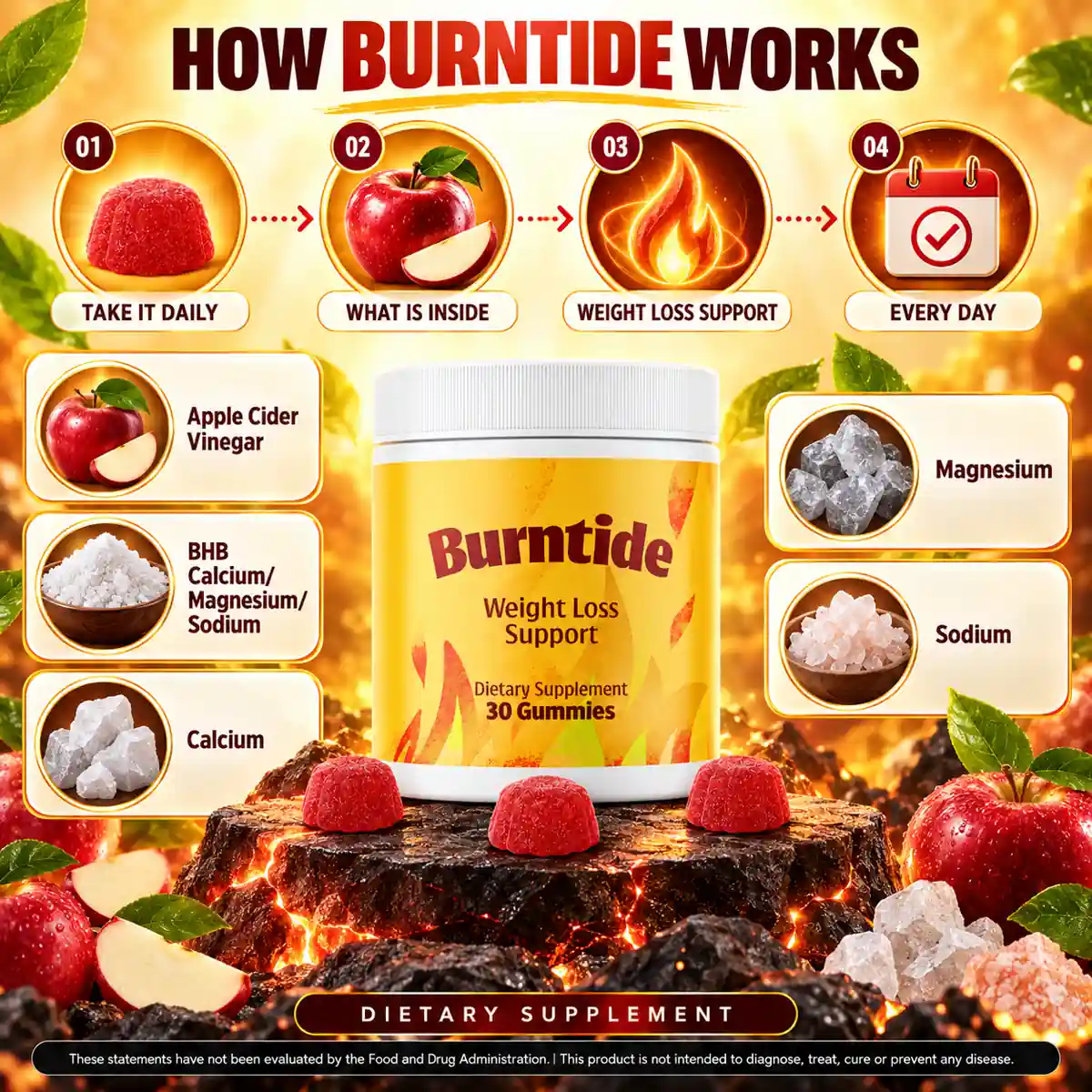
The Burntide diagram, step by step, checked against the label
| The manufacturer's step | Does the label support it? | This desk's reading |
|---|---|---|
| Step 1: the gummy is chewed and the blend is released | Supported | Ordinary and uncontroversial. It is what a chewable does. |
| Step 2: apple cider vinegar supports the response to a meal | Supported as a mechanism, not at this amount | The mechanism has human evidence behind it at tablespoon doses of liquid vinegar. 525 mg shared with three salts is a different quantity. |
| Step 3: BHB salts support clean cellular energy | Supported as a mechanism, not at this amount | Ketones are a genuine fuel. Raising blood ketones takes grams, and the panel does not publish how many milligrams are here. |
| Step 4: the body's natural fat-burning pathways are supported | This is a label claim, not a mechanism | “Support the body's natural fat-burning pathways” is a structure and function statement. It describes an intention, not a demonstrated effect of this product. |
The diagram is not dishonest. Read as a description of two ingredient mechanisms it is broadly fair, and the fourth step is written in the careful structure and function language United States rules require. What it does not do, and what no marketing diagram in this category does, is put the amounts next to the mechanisms. That is the job this website took on.
What actually happens in the hour after a Burntide gummy
Nothing dramatic. Here is the honest version of the first hour.
Minute 0: you chew it
A 2.5 g gummy with 2 g of sugar in it. It tastes sweet with a faint sourness from the citric acid and the vinegar.
Minutes 5 to 20: it clears the stomach
Sugar, pectin and a few hundred milligrams of blend. Nothing you can feel, and nothing that should be felt.
Minute 30: the meal arrives
This is the point of the timing. If the vinegar is doing anything at all, it is doing it to the meal that follows it.
If you feel a strong effect from a Burntide gummy in the first hour, the most likely explanations are the sugar, the expectation, or something else entirely. That is not a criticism of the product; it is what a 525 mg blend should be expected to do, and expecting more is how people end up disappointed in week one.
Three tests, and how Burntide scores on each
Three things have to be true for a supplement like this one to do anything measurable, and this label satisfies one and a half of them.
- The ingredient has to have a plausible mechanism. Both of these do, with human evidence behind them. This one is satisfied.
- The amount has to be in the range that produced the effect. It is not, for either ingredient, by a wide margin. This one is not satisfied.
- The form has to deliver it. Dried vinegar in a chewable is a plausible carrier; whether it behaves like liquid vinegar against a meal has not been tested. Call this one half.
A reader who takes only one thing from this page should take that list. It is the same test worth applying to any supplement in this category, and the choosing a gummy supplement guide turns it into a checklist you can carry to another label.
What is left, when the dose argument is honest, is a daily habit attached to a meal. Six of the eight reviewers on record describe exactly that, and the reviews page publishes it in full.
What people ask about the Burntide mechanism
How does Burntide work?
It pairs apple cider vinegar, studied for the glucose and satiety response to a meal, with beta-hydroxybutyrate salts, studied as a fuel and a signalling molecule. Both sit in one 525 mg blend taken about 30 minutes before a meal.
Does Burntide put you in ketosis?
No. Raising blood ketones measurably takes grams of exogenous ketones. The ketone salts in this gummy are, by this desk's arithmetic from the mineral rows, around 27 mg.
Why does Burntide say 30 minutes before a meal?
It is the label's own instruction, and it matches how the vinegar research dosed vinegar: with or shortly before food, because the measured effects were effects on a meal.
Does Burntide act on body fat directly?
No. The label says it supports the body's natural fat-burning pathways, which is a structure and function statement about supporting a process. Nothing in a 525 mg blend oxidises body fat.
Will I feel Burntide working?
Probably not, and you should not expect to. A 525 mg blend taken before a meal is not a sensation. The review record is about a habit over weeks, not an effect in an hour.
Research behind this Burntide page
Every source below was opened and checked, and every PubMed record was confirmed against the NCBI record before it was written down. None of them studied Burntide itself. They concern the ingredients, at the amounts the researchers used.
- Ostman E, Granfeldt Y, Persson L, Bjorck I. Vinegar supplementation lowers glucose and insulin responses and increases satiety after a bread meal in healthy subjects. Eur J Clin Nutr. 2005;59(9):983-8. PMID 16015276. https://pubmed.ncbi.nlm.nih.gov/16015276/
- Johnston CS, Kim CM, Buller AJ. Vinegar improves insulin sensitivity to a high-carbohydrate meal in subjects with insulin resistance or type 2 diabetes. Diabetes Care. 2004;27(1):281-2. PMID 14694010. https://pubmed.ncbi.nlm.nih.gov/14694010/
- Hlebowicz J, Darwiche G, Bjorgell O, Almer LO. Effect of apple cider vinegar on delayed gastric emptying in patients with type 1 diabetes mellitus: a pilot study. BMC Gastroenterol. 2007;7:46. PMID 18093343. https://pubmed.ncbi.nlm.nih.gov/18093343/
- Kondo T, Kishi M, Fushimi T, Ugajin S, Kaga T. Vinegar intake reduces body weight, body fat mass, and serum triglyceride levels in obese Japanese subjects. Biosci Biotechnol Biochem. 2009;73(8):1837-43. PMID 19661687. https://pubmed.ncbi.nlm.nih.gov/19661687/
- Arjmandfard D, Behzadi M, Sohrabi Z, et al. Effects of apple cider vinegar on glycemic control and insulin sensitivity in patients with type 2 diabetes: a GRADE-assessed systematic review and dose-response meta-analysis of controlled clinical trials. Front Nutr. 2025;12:1528383. PMID 39949546. https://pubmed.ncbi.nlm.nih.gov/39949546/
- Launholt TL, Kristiansen CB, Hjorth P. Safety and side effects of apple vinegar intake and its effect on metabolic parameters and body weight: a systematic review. Eur J Nutr. 2020;59(6):2273-2289. PMID 32170375. https://pubmed.ncbi.nlm.nih.gov/32170375/
- Stubbs BJ, Cox PJ, Evans RD, et al. On the metabolism of exogenous ketones in humans. Front Physiol. 2017;8:848. PMID 29163194. https://pubmed.ncbi.nlm.nih.gov/29163194/
- Stubbs BJ, Cox PJ, Evans RD, Cyranka M, Clarke K, de Wet H. A ketone ester drink lowers human ghrelin and appetite. Obesity (Silver Spring). 2018;26(2):269-273. PMID 29105987. https://pubmed.ncbi.nlm.nih.gov/29105987/
- Newman JC, Verdin E. Beta-hydroxybutyrate: a signaling metabolite. Annu Rev Nutr. 2017;37:51-76. PMID 28826372. https://pubmed.ncbi.nlm.nih.gov/28826372/
- Evans M, Cogan KE, Egan B. Metabolism of ketone bodies during exercise and training: physiological basis for exogenous supplementation. J Physiol. 2017;595(9):2857-2871. PMID 27861911. https://pubmed.ncbi.nlm.nih.gov/27861911/
- Evans M, McClure TS, Koutnik AP, Egan B. Exogenous ketone supplements in athletic contexts: past, present, and future. Sports Med. 2022;52(Suppl 1):25-67. PMID 36214993. https://pubmed.ncbi.nlm.nih.gov/36214993/

Every page, every journal post, the bottle facts and the ingredients go through review by Dr. Wendy Scinta, MD before they ship. We write these pages from the Burntide Supplement Facts panel photographed on the jar and from the distributor’s own paperwork. Every amount you read here is one the label prints. Apple cider vinegar and the BHB salts have no amount of their own, because they share one 525 mg blend figure, and we print “not published” for those rather than estimating a split. Research is cited by author, year and PubMed record, at the amounts the researchers used. Where a piece of the manufacturer’s own artwork reaches further than the panel does, this desk marks it on the page rather than reprinting it. Corrections are made on the page itself and the review date moves forward. Write to [email protected]. Last reviewed September 2026 by Dr. Wendy Scinta, MD.
More Burntide label reading
Order Burntide on the official website
Two mechanisms, one blend, and sixty days to decide for yourself.
Price and pack sizes are shown on the checkout page
Order Burntide On The Official WebsiteOne gummy a day · 30 per jar · 60-day money-back guarantee · lot BUR-26/BU-8141