Burntide Official Website › Choosing A Gummy Supplement
Choosing a gummy supplement: a nine-point checklist
Nine checks you can run on any gummy supplement in about five minutes, using nothing but the jar. They cover the serving weight, what share of the gummy is active, whether amounts are published, how they compare against the research, the added sugar, the second ingredient list, the batch codes, the returns route and the seals.
Then the same nine applied to Burntide. It scores seven. Both failures are printed at the same size as the passes.
Why a gummy needs its own checklist
A gummy supplement is a confectionery product with a small amount of something else in it. That is not a criticism, it is a description, and it is the reason a gummy needs a different checklist from a capsule. A capsule can be almost entirely active. A gummy cannot: it needs a gel, a sweetener and a flavour before anything else goes in.
So the questions that matter are about proportions and about what is published, not about marketing language. Nine of them are below. They work on any jar and they need nothing but the panel and five minutes.
The nine checks
Does it print a serving weight?
A gummy that does not tell you what one gummy weighs cannot tell you what fraction of it is the supplement. The serving weight is the denominator for every other number on the panel.
Can you work out what share of the gummy is active?
Divide the active total by the serving weight. If the answer is a few per cent, you are mostly buying confectionery, and that is worth knowing rather than discovering.
Does every active carry its own amount?
This is the check most gummies fail. An ingredient inside a proprietary blend has no amount of its own and cannot be compared against anything.
Are the amounts in the range the research used?
Look up the headline ingredient, find the dose in the trials, and compare it against the amount on the panel or against the blend ceiling.
Does it print the added sugar?
A gummy needs sugar to set. The panel has to declare added sugars separately from total sugars, and a product that is coy about it in its marketing is telling you something.
Is the second ingredient list readable?
Other Ingredients is in descending order of weight and is where the bulk of a gummy actually is. If the first entry there outweighs the actives, that is the honest description of the product.
Does it name a form, a lot and a label revision?
A lot code lets a seller match your jar to a production run. A label revision lets you check the panel you read online is the panel on the jar you hold.
Is there a real returns route with a real address?
A window, a telephone number that answers and a street address you can post to. This is the check that separates a supplement from a scam, and it has nothing to do with the formula.
Are the seals explained rather than displayed?
Seals describe processes. A page that reproduces ten of them without saying what any of them means is decorating rather than informing.
The nine checks applied to Burntide
| # | Check | Result | What the label shows |
|---|---|---|---|
| 1 | Does it print a serving weight? | Pass | 1 Gummy (2.5 g per gummy). The weight is printed in the serving size line. |
| 2 | Can you work out what share of the gummy is active? | Pass | 525 mg of a 2.5 g gummy is about 21 per cent. The arithmetic is possible because both numbers are printed. |
| 3 | Does every active carry its own amount? | Fail | Apple cider vinegar and the three BHB salts share one 525 mg figure. The three mineral rows do carry their own amounts, so this is a partial failure rather than a total one, and it is still a failure. |
| 4 | Are the amounts in the range the research used? | Fail | 525 mg is the ceiling for both named actives together. The vinegar trials used 15 to 30 mL of liquid vinegar and the ketone work used 10 to 25 g drinks. The gap is large and this website prints it in a table. |
| 5 | Does it print the added sugar? | Pass | 2 g total sugars of which 1 g is added, at 2% of the Daily Value. Printed plainly. |
| 6 | Is the second ingredient list readable? | Pass | Nine items, corn syrup first. That does put the bulk sweetener above the blend by weight, and the panel says so. |
| 7 | Does it name a form, a lot and a label revision? | Pass | Lot BUR-26/BU-8141, certificate reference BUR-8141-26-BU, label revision REV 04/24. All three are printed and all three are on this website. |
| 8 | Is there a real returns route with a real address? | Pass | 60 days from purchase, +1 (631) 016-1313, and returns to 275 Madison Avenue, Floor 14, New York, NY 10016. Return postage is the buyer's, which is stated up front. |
| 9 | Are the seals explained rather than displayed? | Pass | All ten are explained on the testing and quality page, including two this desk pushes back on: Natural Ingredients and Doctor Formulated. |
Seven passes and two failures. The two failures are checks three and four, and they are the same failure looked at twice: the label does not publish how the 525 mg splits, and the ceiling is well below the amounts the research used.
Those two are also the two that matter most to anybody asking whether a supplement will do something. The seven passes are about honesty, traceability and whether there is somebody to call. Both sets are worth having and they answer different questions.
Why publish a checklist this product fails. Because a checklist tuned so that the product being sold scores nine out of nine is not a checklist, it is an advertisement with numbers on it. The two failures above are the reason the seven passes are worth anything at all.
Using the checklist on somebody else's jar
Run the same nine on the next jar you pick up and you will find the pattern quickly. In this category, most products pass the traceability checks and fail the amount checks, for the same reason: a proprietary blend is cheap to print and a published split is not.
Three things to watch for that are not on the list because they are not label facts:
- A page that prints a research dose beside a product that does not contain it. Look for whether the dose quoted is the product’s or the study’s. The two are frequently placed next to each other with nothing separating them.
- A “clinically studied ingredients” phrase. It means the ingredient has been studied somewhere by somebody at some dose. It does not mean this product was studied, and the distinction is doing enormous work.
- A seal wall with no explanation. Ten marks and no text is decoration. The FDA is clear that supplements are not approved, so no seal can mean approval however official it looks.
The NIH fact sheet on weight-loss supplements is the most useful single document if this is the category you are shopping in. It reviews the evidence ingredient by ingredient and it is not selling anything.
What nine checks cannot tell you
The checklist deliberately contains no question about whether the product works, and that is not an oversight.
Nine label checks cannot answer that question, and neither can a review page, a seal or a guarantee. The only thing that answers it is a controlled trial on the finished product, and Burntide has not had one. Neither has almost anything else on the shelf beside it.
What the checklist can do is tell you whether you are being told the truth about what you are buying, which is a smaller question and an answerable one. A product that publishes its amounts, prints its sugar, names its batch and answers its telephone has earned a trial at your own expense. A product that does none of those has not.
Burntide sits in between, which is the honest place for it: it publishes most things and withholds the one that would invite the least flattering comparison. That is what seven out of nine looks like, and it is more than most of this category manages.
Research behind this Burntide page
Every source below was opened and checked, and every PubMed record was confirmed against the NCBI record before it was written down. None of them studied Burntide itself. They concern the ingredients, at the amounts the researchers used.
- U.S. Food and Drug Administration. Dietary Supplement Labeling Guide. https://www.fda.gov/food/dietary-supplements-guidance-documents-regulatory-information/dietary-supplement-labeling-guide
- U.S. Food and Drug Administration. Questions and Answers on Dietary Supplements. https://www.fda.gov/food/information-consumers-using-dietary-supplements/questions-and-answers-dietary-supplements
- National Institutes of Health, Office of Dietary Supplements. Dietary Supplements for Weight Loss: Fact Sheet for Health Professionals. https://ods.od.nih.gov/factsheets/WeightLoss-HealthProfessional/
- National Institutes of Health, Office of Dietary Supplements. Dietary Supplements: What You Need to Know. https://ods.od.nih.gov/factsheets/WYNTK-Consumer/
- Kondo T, Kishi M, Fushimi T, Ugajin S, Kaga T. Vinegar intake reduces body weight, body fat mass, and serum triglyceride levels in obese Japanese subjects. Biosci Biotechnol Biochem. 2009;73(8):1837-43. PMID 19661687. https://pubmed.ncbi.nlm.nih.gov/19661687/
- Stubbs BJ, Cox PJ, Evans RD, et al. On the metabolism of exogenous ketones in humans. Front Physiol. 2017;8:848. PMID 29163194. https://pubmed.ncbi.nlm.nih.gov/29163194/
- Rios-Hoyo A, Gutierrez-Salmean G. New dietary supplements for obesity: what we currently know. Curr Obes Rep. 2016;5(2):262-70. PMID 27053066. https://pubmed.ncbi.nlm.nih.gov/27053066/
- U.S. National Library of Medicine, MedlinePlus. Dietary Supplements. https://medlineplus.gov/dietarysupplements.html

Every page, every journal post, the bottle facts and the ingredients go through review by Dr. Wendy Scinta, MD before they ship. We write these pages from the Burntide Supplement Facts panel photographed on the jar and from the distributor’s own paperwork. Every amount you read here is one the label prints. Apple cider vinegar and the BHB salts have no amount of their own, because they share one 525 mg blend figure, and we print “not published” for those rather than estimating a split. Research is cited by author, year and PubMed record, at the amounts the researchers used. Where a piece of the manufacturer’s own artwork reaches further than the panel does, this desk marks it on the page rather than reprinting it. Corrections are made on the page itself and the review date moves forward. Write to [email protected]. Last reviewed September 2026 by Dr. Wendy Scinta, MD.
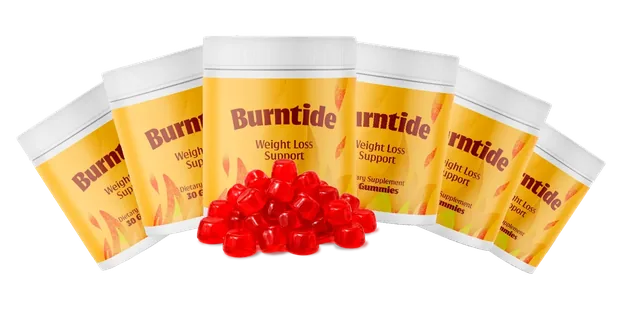
Order Burntide on the official website
Seven out of nine on this website's own checklist, with both failures printed.
Price and pack sizes are shown on the checkout page
Order Burntide On The Official WebsiteOne gummy a day · 30 per jar · 60-day money-back guarantee · lot BUR-26/BU-8141