Burntide Official Website › Blog › Other ingredients
Other Ingredients: The Second List On A Gummy Label
- Other Ingredients is a second, separate list, printed under the Supplement Facts box rather than inside it. Nothing on it is an active.
- It is in descending order of weight, which means the first entry is the largest single component of the product.
- On the Burntide label the first entry is corn syrup, which places it above the 525 mg blend.
- It is where allergens, sweeteners, colours and fillers live. If you are avoiding something, this is the list to read, not the panel.
- “Natural flavors” is a legal category, not an ingredient. No supplement label has to say which flavours.
Why a supplement label has two ingredient lists
A dietary supplement label separates what the product is for from what the product is made of, and it prints them in two different places.
Inside the Supplement Facts box go the dietary ingredients: nutrients with a Daily Value, other actives, and any proprietary blend. Outside the box, underneath it, goes everything else, headed Other Ingredients. The FDA labelling guide sets out which goes where.
On a capsule the second list is usually short and dull: a shell, an anti-caking agent, maybe a colour. On a gummy it is long, and it is most of the product by weight. That is the reason this post exists.
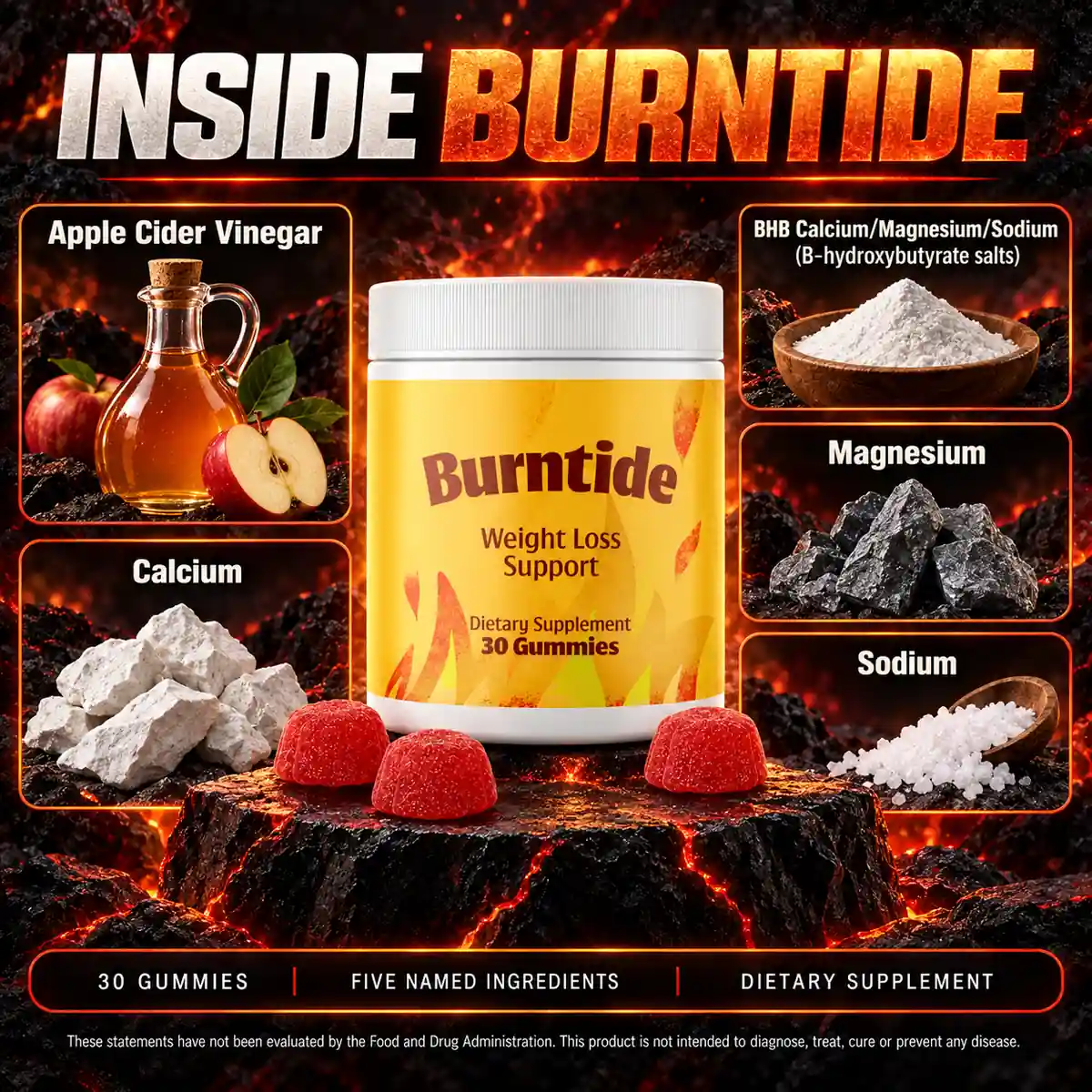
The nine items on this label, one at a time
Burntide prints nine, in this order: corn syrup, purified water, pure cane sugar, apple pectin, citric acid, sodium citrate, tapioca starch, natural flavors and beet root powder.
| # | Ingredient | Category | What it does here |
|---|---|---|---|
| 1 | Corn syrup | Sweetener and bulking agent | The body of the gummy. First on the list, so the heaviest single component |
| 2 | Purified water | Solvent | The gel is made in water. Most of it leaves during setting |
| 3 | Pure cane sugar | Sweetener | The second sweetener, and part of why the panel declares 1 g of added sugars |
| 4 | Apple pectin | Gelling agent | A fruit-derived gel. It is what makes a vegetarian claim possible on a chewable |
| 5 | Citric acid | Acidulant | Sourness and pH. Nothing to do with the apple cider vinegar in the blend |
| 6 | Sodium citrate | Buffer | Controls acidity with the citric acid, and contributes sodium |
| 7 | Tapioca starch | Anti-sticking agent | Dusted on so thirty gummies do not become one gummy in a warm parcel |
| 8 | Natural flavors | Flavouring | A legal category. The label does not say which flavours and does not have to |
| 9 | Beet root powder | Colour | The red. A vegetable colour rather than a synthetic dye |
Nothing on that list is unusual and nothing on it is hidden. What is notable is only that it exists at this length, and that its first entry outweighs the blend the product is sold for.
What descending order actually tells you
Both ingredient lists on a supplement label are in descending order of weight. That single rule is the most useful thing on any label, and it works on food packaging too.
It tells you three things here:
- Corn syrup is the largest component of the gummy, ahead of the 525 mg blend and ahead of the cane sugar.
- Water is second, which is ordinary for a gel product and which explains why the finished gummy weighs more than the sum of its dry parts suggests.
- Beet root powder is last, so the colour is present in trace amounts, which is what you would expect of a colour.
What it does not tell you is the actual weight of any of them. Order is not quantity, and no rule requires an Other Ingredients line to carry numbers. That is the same limitation a proprietary blend has, applied to a different list.
Read the Burntide label yourself
The panel and the Other Ingredients line are both on the jar, photographed and printed in full on this website before you buy anything.
Price shown at checkout · 60-day guarantee
Order Burntide On The Official WebsiteReading it for allergens and avoidances
If you are avoiding something, the Other Ingredients line is the list to read. Actives are rarely the problem; fillers, shells, colours and sweeteners usually are.
| If you are avoiding | What to look for | On the Burntide list |
|---|---|---|
| Gelatin | Gelatin, bovine or porcine gelatin | Absent. Apple pectin is the gelling agent |
| Gluten | Wheat, barley, rye, malt, any starch not named | Absent. Tapioca starch is named and is not a gluten grain |
| Dairy | Milk, lactose, whey, casein | Absent |
| Soy | Soy lecithin, soybean oil | Absent |
| Artificial colour | FD&C numbers, lake colours | Absent. Beet root powder is the colour |
| Added sugar | Corn syrup, cane sugar, glucose syrup, any syrup | Present. Two sweeteners, and the panel declares 1 g of added sugars |
| Sodium | Sodium citrate, sodium benzoate, any sodium salt | Present. Sodium citrate is here and the panel declares 2.5 mg |
Two rows there are the honest ones. The added sugar row and the sodium row are the two where this label has something rather than nothing, and both are declared on the panel as well, so neither is hidden. The FDA's sodium guidance puts the amount in context: 2.5 mg against a 2,300 mg daily ceiling is not a number anyone needs to act on, and it is still worth knowing it is there.
One warning that applies to every label, not just this one. An absence from an ingredient list is a recipe statement, not a test result. “Naturally gluten free” on the jar means there is no gluten grain in the recipe; it does not mean the batch was tested to a threshold. If you have coeliac disease, that distinction matters and MedlinePlus is a better starting point than a seal.
The natural flavors problem
Eighth on the list is “natural flavors”, and it is the one entry that tells you almost nothing.
In United States labelling it is a category term covering flavouring derived from a plant or animal source, and a manufacturer may use it without itemising what is inside. A single “natural flavors” entry can represent one compound or a dozen.
For most people this is irrelevant. For somebody with an unusual food sensitivity it is the end of the road, because the label will not tell them and neither will this website. The only move available is to ask the manufacturer directly and accept that the answer may be that the formulation is proprietary.
It is worth naming as a limit rather than glossing it. A label is a bounded document, and this is one of its boundaries. The panel page lists the others.
What is absent from this list, and why that matters
Reading a second list for what is not there is as useful as reading it for what is.
- No caffeine and no stimulant. Neither list carries one, which matters on a product sold for metabolism support, because a stimulant is the easiest way to make one feel like it is working.
- No artificial sweetener. No sucralose, aspartame or acesulfame. The sweetness is sugar, which is a choice with a visible cost on the panel.
- No sugar alcohol. No maltitol, sorbitol or xylitol, which is worth knowing because those are the usual route to a low-sugar gummy and they bring their own digestive effects.
- No preservative named. The citric acid and the sodium citrate are doing pH work that contributes to shelf stability.
- No gelatin, gluten grain, dairy or soy, as set out above.
That is an unusually clean list for a gummy, and saying so is fair. The cost of it is the sugar, because a gummy without artificial sweeteners or sugar alcohols has to get its sweetness from somewhere.
Two traps in reading an Other Ingredients line
Both are common and both lead to the wrong conclusion.
Treating list length as quality. A short list looks cleaner and tells you almost nothing. A capsule can have three entries and a gummy nine because a gel needs more parts than a shell does, and neither fact says anything about what is inside. Judge the entries, not the count.
Assuming an unfamiliar name is a problem. Sodium citrate sounds industrial and is a buffer found in cheese and soft drinks. Tapioca starch sounds wholesome and is doing the least interesting job on the list. The name tells you about its origin, not about whether it belongs there.
The useful questions are narrower: is the first entry what you expect, is anything here that you personally avoid, and is any entry a category term that hides several things. Everything else on the list is engineering.
One more thing worth noticing on this particular label. There is no preservative named, no artificial colour and no sugar alcohol, and that is unusual enough in a gummy to be worth saying out loud. Whether it matters to you is a separate question, and the testing and quality page deals with the seals that make claims about it.
Using the second list on any jar
Four questions, on any supplement in any shop, in about a minute.
- What is first? That is the largest component. On a gummy it is nearly always a sweetener, and if it is not, something interesting is going on.
- How long is the list? Nine is ordinary for a gummy. Twenty is worth a second look.
- Is anything on it that you avoid? This is the list, not the panel.
- Is there a category term doing a lot of work? “Natural flavors”, “proprietary flavour blend”, “other ingredients as needed”. Each one is a gap in what you can know.
The NIH consumer guidance and the FDA's consumer questions and answers both cover the regulatory background if you want it. Neither is selling anything, which is why both are better first reading than any product page, including this one.
On this website, the actives and amounts page handles the first list and the panel page handles the second. Between them they print every word on the jar.
Sources cited in this post
- U.S. Food and Drug Administration. Dietary Supplement Labeling Guide. https://www.fda.gov/food/dietary-supplements-guidance-documents-regulatory-information/dietary-supplement-labeling-guide
- U.S. Food and Drug Administration. Questions and Answers on Dietary Supplements. https://www.fda.gov/food/information-consumers-using-dietary-supplements/questions-and-answers-dietary-supplements
- National Institutes of Health, Office of Dietary Supplements. Dietary Supplements: What You Need to Know. https://ods.od.nih.gov/factsheets/WYNTK-Consumer/
- U.S. National Library of Medicine, MedlinePlus. Dietary Supplements. https://medlineplus.gov/dietarysupplements.html
- U.S. Food and Drug Administration. Sodium in Your Diet: Use the Nutrition Facts Label and Reduce Your Intake. https://www.fda.gov/food/nutrition-education-resources-materials/sodium-your-diet

Every page, every journal post, the bottle facts and the ingredients go through review by Dr. Wendy Scinta, MD before they ship. We write from the Burntide label, the Supplement Facts panel photographed on the jar, and the distributor’s own paperwork. Sources are linked inline and every one was opened before it was cited. Where a figure is not disclosed we print “not published” rather than estimating it, and where we do arithmetic we show the working and name the assumption. Corrections go to [email protected] and move the date at the top of this post.