Burntide Official Website › Blog › Zero percent Daily Value
Zero Percent Daily Value: What Those Mineral Rows Mean
- A Daily Value is a reference intake for a whole day. A per cent on a panel is the share of that reference one serving supplies.
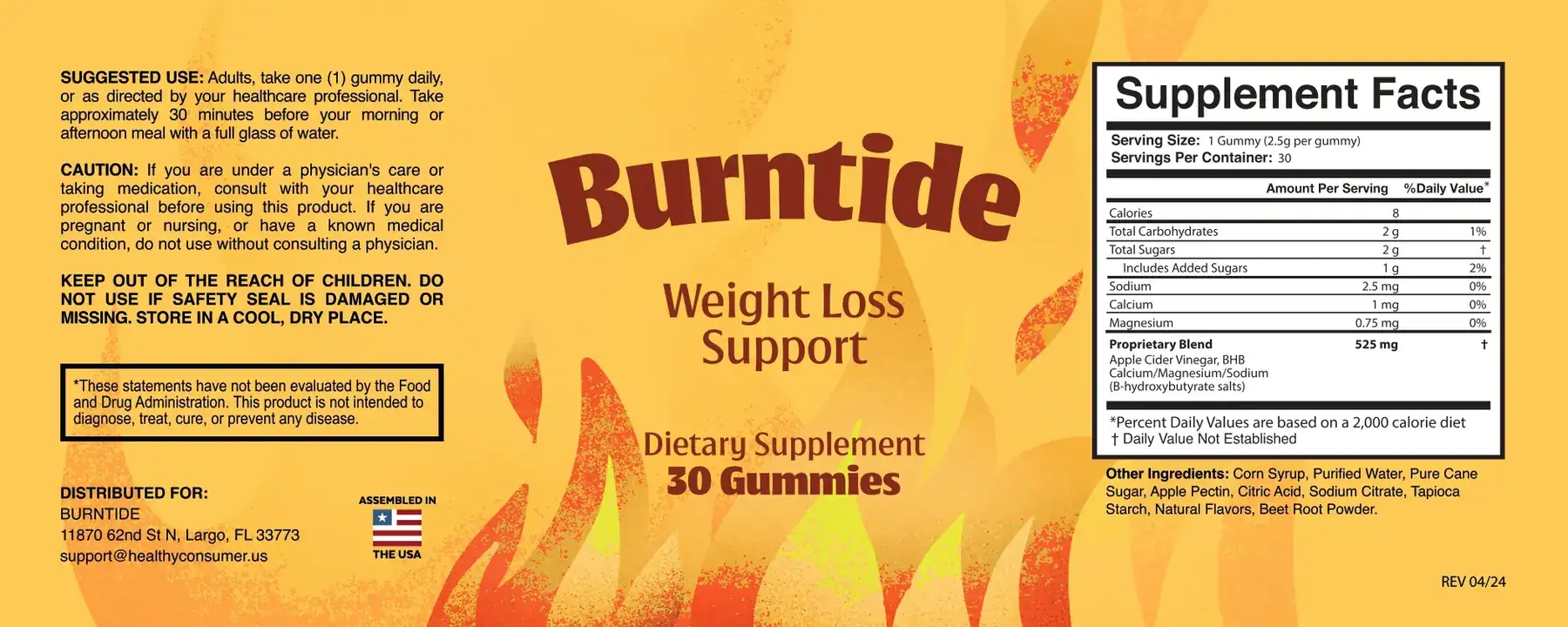
- On the Burntide panel, sodium 2.5 mg, calcium 1 mg and magnesium 0.75 mg all round to 0%.
- 0% is not an error and not a trick. It means the amount is small against the reference, and rounding rules take it to zero.
- The minerals are there because they are the counter-ions on the ketone salts, not because this is a mineral supplement.
- A dagger is different from a zero. It means no Daily Value has been established for that row at all.
What a Daily Value actually is
A Daily Value is a single reference number per nutrient, set for labelling purposes so that every product in the shop can be compared on the same scale. It is not a personal requirement, it is not a target for everybody, and for some nutrients it is a ceiling rather than a goal.
The percentage on a panel is arithmetic: the amount in one serving, divided by the Daily Value, expressed as a percentage and rounded. The FDA labelling guide sets out both the values and the rounding rules.
So a row reading 25% means a serving supplies a quarter of the reference. A row reading 0% means it supplies so little that the rounding takes it to nothing.
The three rows on this panel, calculated
Here is the division, done in public, so that 0% stops being mysterious.
| Nutrient | On this label | Daily Value | Actual percentage | As printed |
|---|---|---|---|---|
| Sodium | 2.5 mg | 2,300 mg | 0.11% | 0% |
| Calcium | 1 mg | 1,300 mg | 0.08% | 0% |
| Magnesium | 0.75 mg | 420 mg | 0.18% | 0% |
All three are under a fifth of one per cent, so all three round to zero. The reference intakes come from the NIH calcium fact sheet and the magnesium fact sheet; sodium is a ceiling rather than a target, which the FDA and the CDC both explain.
To put the magnesium in ordinary terms: at 0.75 mg a gummy you would need roughly 560 gummies, or about nineteen jars, to reach one day’s reference intake. Nobody should do that and nothing about the product suggests it.
Why a label declares a nutrient it barely supplies
Because the rules require it. If a nutrient with a Daily Value is present, the label declares how much, whatever the amount.
These three are present for a specific reason. Beta-hydroxybutyrate is an acid, so it is sold bound to a mineral: calcium beta-hydroxybutyrate, magnesium beta-hydroxybutyrate, sodium beta-hydroxybutyrate. When the salt goes into the gummy, the mineral half comes with it and must be counted.
That is why the three rows exist and why they are so small. They are a by-product of the ketone salts in the blend, not a deliberate mineral addition. The sodium is the one exception worth flagging: sodium citrate on the Other Ingredients line is a second source of it, which is why the arithmetic on the panel page treats the sodium step as its weakest.
The Burntide panel, printed in full
Every row, both symbols and the Other Ingredients line, read one at a time before you decide anything.
Price shown at checkout · 60-day guarantee
Order Burntide On The Official WebsiteA dagger is not a zero
Two of the rows on this panel carry a dagger instead of a percentage, and the difference matters.
| Symbol | Means | On this panel | What it tells you |
|---|---|---|---|
| 0% | A Daily Value exists and this serving supplies almost none of it | Sodium, calcium, magnesium | The amount is small against a known reference |
| † | No Daily Value has been established for this row | Total sugars, and the proprietary blend | There is no reference intake to compare against at all |
| An asterisk | Refers to the footnote about a 2,000 calorie diet | The %Daily Value column header | Which reference diet the percentages assume |
People read the dagger as a warning and it is not one. It is a statement that the FDA has not set a reference intake for that substance, which for apple cider vinegar and beta-hydroxybutyrate is simply true: there is no recommended daily intake of either.
The practical consequence is that a dagger row cannot be judged by its percentage, because it has none. It has to be judged against the research literature instead, which is what the actives and amounts page does.
Reading percentages without being misled
Three habits are worth having, and all three work on food labels too.
- High percentages are not automatically good. A 200% Daily Value of something is not twice as useful as 100%, and for a handful of nutrients it is worse. Look for what the nutrient is before admiring the number.
- A ceiling nutrient reads backwards. Sodium’s Daily Value is a limit, so a high percentage there is a reason for concern rather than a selling point.
- Zero can be a feature. On this panel, 0% sodium is genuinely good news for anybody watching sodium, and it is printed in exactly the same typeface as everything else.
The National Institute on Aging has a short page aimed at older adults on reading supplement labels, and it is the most readable version of this if you want to send one to a relative.
What a meaningful mineral row would look like
For contrast, here is what these rows would look like on a product that was actually supplying these minerals.
| Nutrient | On Burntide | On a typical mineral supplement | Difference |
|---|---|---|---|
| Calcium | 1 mg (0%) | 500 mg (38%) | about 500-fold |
| Magnesium | 0.75 mg (0%) | 200 mg (48%) | about 270-fold |
| Sodium | 2.5 mg (0%) | not supplemented | not comparable |
That table is not a criticism. Burntide is not sold as a mineral supplement and does not claim to be one. The table is here because the most common misreading of this panel is that three named minerals mean three supplemented minerals, and the numbers say otherwise.
If you need calcium or magnesium, buy calcium or magnesium. The who-it-is-for page says the same thing about several other reasons people consider this product.
Where Daily Values come from, and why they change
A Daily Value is not a law of nature. It is a labelling reference set by a regulator, drawn from population nutrition science and revised when that science moves.
The values used on United States panels were last substantially revised in the 2016 label overhaul, which is why older packaging and newer packaging can show different percentages for the same amount of the same nutrient. Calcium’s reference moved, magnesium’s moved, and added sugars gained a Daily Value it had never had before.
Two consequences for a reader:
- A percentage is only comparable within the same labelling era. Comparing a percentage on a new jar against one printed on an old one is comparing against two different references.
- The amount is the durable number. Milligrams do not change when a reference does, which is why every comparison on this website is done in milligrams and the percentage is treated as a convenience.
The NIH calcium fact sheet and the magnesium fact sheet publish the underlying intake recommendations by age and sex, which are more granular than any single labelling number can be. If you actually need to know what you should be getting, those are the documents rather than a panel.
The other kind of zero on a supplement label
There is a second zero that appears on panels and it means something quite different.
A row reading 0 g rather than 0% is a statement about the amount rather than about a percentage. Under rounding rules a small amount of fat, protein or carbohydrate can legally be declared as zero, which is how a product can contain a trace of something and print nothing. This panel has no such row: its carbohydrate, sugar and mineral amounts are all printed as real numbers.
The practical difference is worth holding on to. 0% means a real amount that is small against a reference. 0 g means an amount too small to declare. The first is what you see three times on this label, and it is the more informative of the two, because you can still read the milligrams beside it and do your own arithmetic.
That is a general point about this panel and the reason this website leads with it: almost everything on it is a real number you can check. The single exception is the blend, which is a real number for two ingredients at once, and the proprietary blends guide is about exactly that.
The practical answer for a buyer
Three sentences, if this is the only part you read.
The three 0% rows on this panel are honest arithmetic on small amounts, and they are there because the ketone salts brought their minerals with them. They mean this product will not contribute meaningfully to your calcium, magnesium or sodium intake in either direction. And the rows worth your attention on this panel are the ones with a dagger, because those are the ones the label declines to compare against anything.
Everything on this page is checkable on the jar in front of you, which is the entire reason it is written this way.
Sources cited in this post
- National Institutes of Health, Office of Dietary Supplements. Calcium: Fact Sheet for Health Professionals. https://ods.od.nih.gov/factsheets/Calcium-HealthProfessional/
- National Institutes of Health, Office of Dietary Supplements. Magnesium: Fact Sheet for Health Professionals. https://ods.od.nih.gov/factsheets/Magnesium-HealthProfessional/
- U.S. Food and Drug Administration. Sodium in Your Diet: Use the Nutrition Facts Label and Reduce Your Intake. https://www.fda.gov/food/nutrition-education-resources-materials/sodium-your-diet
- Centers for Disease Control and Prevention. About Sodium and Health. https://www.cdc.gov/salt/about/index.html
- U.S. Food and Drug Administration. Dietary Supplement Labeling Guide. https://www.fda.gov/food/dietary-supplements-guidance-documents-regulatory-information/dietary-supplement-labeling-guide
- National Institute on Aging. Dietary Supplements for Older Adults. https://www.nia.nih.gov/health/vitamins-and-supplements/dietary-supplements-older-adults

Every page, every journal post, the bottle facts and the ingredients go through review by Dr. Wendy Scinta, MD before they ship. We write from the Burntide label, the Supplement Facts panel photographed on the jar, and the distributor’s own paperwork. Sources are linked inline and every one was opened before it was cited. Where a figure is not disclosed we print “not published” rather than estimating it, and where we do arithmetic we show the working and name the assumption. Corrections go to [email protected] and move the date at the top of this post.